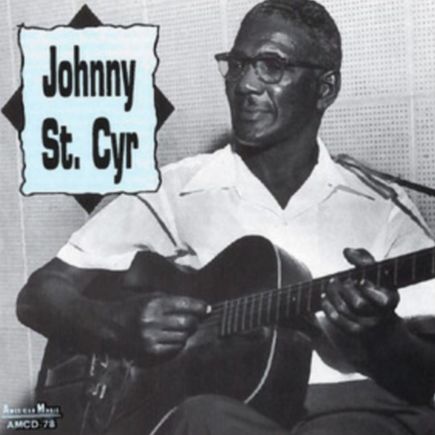
Johnny Saint-Cyr, une voix rythmique fondamentale des origines du jazz
Figure essentielle du jazz traditionnel, Johnny Saint-Cyr s’est imposé comme l’un des premiers banjoïstes d’orchestre à donner à l’instrument un rôle structurant au sein des ensembles de la Nouvelle-Orléans. Par son jeu vif, régulier et remarquablement précis, il contribue à définir la pulsation caractéristique des premières formations créoles et s’impose rapidement comme un accompagnateur recherché dans un contexte où le banjo, plus percussif que la guitare, assurait la cohésion rythmique dans les environnements bruyants des parades et des salles de danse.
Né dans une ville où la musique s’apprend autant dans la rue que dans les fanfares locales, Johnny Saint-Cyr collabore dès ses jeunes années avec plusieurs orchestres emblématiques. Il joue notamment auprès de Freddie Keppard, Papa Celestin, Kid Ory ou encore Armand J. Piron, avec lequel il reste un temps prolongé. Après un passage marquant au sein de l’orchestre de Martin Gabriel, il rejoint en 1909 le Tuxedo Jazz Band de Kid Ory, formation avec laquelle il affine son sens de l’accompagnement jusqu’en 1916. Son expérience se consolide ensuite sur les bateaux à aubes, aux côtés de Fate Marable, dans un environnement musical exigeant qui impose rigueur et polyvalence.
En 1921, persuadé qu’un musicien devait rester un travailleur parmi les autres, Johnny Saint-Cyr met temporairement la musique de côté pour exercer son métier de plâtrier, tout en continuant à se produire localement avec des figures telles qu’Alphonse Picou ou Paul Barbarin. Deux ans plus tard, il suit le mouvement migratoire vers le Nord et s’installe à Chicago, où il rejoint le Creole Jazz Band de King Oliver. Cette collaboration, décisive, le place au cœur de l’effervescence du jazz émergent.
En 1923, il participe aux enregistrements du légendaire Hot Five de Louis Armstrong, formation strictement studio mais déterminante pour l’histoire du jazz. On y retrouve Oriental Street, l’une de ses rares compositions, aux côtés de titres fondateurs tels que Heebie Jeebies ou Cornet Chop Suey. Il enregistre également avec les Red Hot Peppers de Jelly Roll Morton, apportant son soutien rythmique à des sessions devenues historiques. Plus tard, il signe son propre album, Johnny Saint and his Hot Five, publié par le label South, et reçoit en 1951 le All Time All Star Award du Record Changer pour son rôle pionnier au banjo.
Johnny Saint-Cyr, una voz rítmica fundamental de los orígenes del jazz
Johnny Saint-Cyr, figura esencial del jazz tradicional, se impuso como uno de los primeros banjoístas de orquesta en otorgar al instrumento un papel estructurante dentro de los conjuntos de Nueva Orleans. Con un estilo ágil, constante y de notable precisión, contribuyó a definir la pulsación característica de las primeras formaciones criollas y se convirtió rápidamente en un acompañante muy solicitado, en una época en la que el banjo, más percusivo que la guitarra, aseguraba la cohesión rítmica en los ruidosos entornos de los desfiles y los salones de baile.
Nacido en una ciudad donde la música se aprendía tanto en la calle como en las bandas locales, Saint-Cyr colaboró desde muy joven con varias orquestas emblemáticas. Tocó junto a Freddie Keppard, Papa Celestin, Kid Ory y Armand J. Piron, con quien trabajó durante un periodo prolongado. Tras un paso significativo por la orquesta de Martin Gabriel, se unió en 1909 al Tuxedo Jazz Band de Kid Ory, formación con la que perfeccionó su sentido del acompañamiento hasta 1916. Su experiencia se consolidó posteriormente en los barcos de vapor junto a Fate Marable, en un entorno musical exigente que requería rigor y gran versatilidad.
En 1921, convencido de que un músico debía seguir siendo un trabajador entre otros, dejó temporalmente la música para ejercer su oficio de yesero, aunque continuó actuando localmente con figuras como Alphonse Picou o Paul Barbarin. Dos años más tarde, siguió el movimiento migratorio hacia el Norte y se instaló en Chicago, donde ingresó en el Creole Jazz Band de King Oliver. Esta colaboración decisiva lo situó en el corazón de la efervescencia del jazz naciente.
En 1923, participó en las grabaciones del legendario Hot Five de Louis Armstrong, un grupo exclusivamente de estudio pero fundamental para la historia del jazz. Allí figura Oriental Street, una de sus escasas composiciones, junto a temas emblemáticos como Heebie Jeebies y Cornet Chop Suey. También grabó con los Red Hot Peppers de Jelly Roll Morton, aportando un sostén rítmico que marcaría sesiones históricas. Más tarde, publicó su propio disco, Johnny Saint and his Hot Five, bajo el sello South, y en 1951 recibió el All Time All Star Award del Record Changer por su papel pionero en el banjo.
Johnny Saint-Cyr, una voce ritmica fondamentale delle origini del jazz
Johnny Saint-Cyr, figura essenziale del jazz tradizionale, si affermò come uno dei primi banjoisti d’orchestra a conferire allo strumento un ruolo strutturante all’interno degli ensemble di New Orleans. Con un fraseggio agile, regolare e straordinariamente preciso, contribuì a definire la pulsazione tipica delle prime formazioni creole e divenne rapidamente un accompagnatore ricercato, in un contesto in cui il banjo, più percussivo della chitarra, garantiva la coesione ritmica nelle rumorose parate e nelle sale da ballo.
Nato in una città dove la musica si apprendeva tanto per strada quanto nelle bande locali, Saint-Cyr collaborò fin da giovane con diverse orchestre emblematiche. Suonò con Freddie Keppard, Papa Celestin, Kid Ory e Armand J. Piron, con cui rimase per un lungo periodo. Dopo un passaggio significativo nell’orchestra di Martin Gabriel, nel 1909 entrò nel Tuxedo Jazz Band di Kid Ory, formazione con la quale affinò il suo senso dell’accompagnamento fino al 1916. La sua esperienza si consolidò poi sui battelli a vapore al fianco di Fate Marable, in un ambiente musicale esigente che richiedeva rigore e grande versatilità.
Nel 1921, convinto che un musicista dovesse rimanere un lavoratore come gli altri, mise temporaneamente da parte la musica per esercitare il mestiere di muratore, continuando però a esibirsi localmente con figure come Alphonse Picou o Paul Barbarin. Due anni dopo seguì le migrazioni verso il Nord e si stabilì a Chicago, dove entrò nel Creole Jazz Band di King Oliver. Questa collaborazione decisiva lo pose al centro della nascente effervescenza jazzistica.
Nel 1923 partecipò alle registrazioni del leggendario Hot Five di Louis Armstrong, formazione esclusivamente da studio ma determinante per la storia del jazz. Vi figurano Oriental Street, una delle sue rare composizioni, insieme a brani fondamentali come Heebie Jeebies e Cornet Chop Suey. Registrò inoltre con i Red Hot Peppers di Jelly Roll Morton, offrendo un sostegno ritmico che segnò sessioni ormai storiche. Più tardi pubblicò il suo disco Johnny Saint and his Hot Five per l’etichetta South e nel 1951 ricevette l’All Time All Star Award dal Record Changer per il suo ruolo pionieristico al banjo.
Johnny Saint-Cyr, a fundamental rhythmic voice in the origins of jazz
Johnny Saint-Cyr, a key figure in traditional jazz, emerged as one of the first orchestral banjoists to give the instrument a defining role within New Orleans ensembles. With a lively, steady, and remarkably precise style, he helped shape the characteristic pulse of early Creole bands and quickly became a sought-after accompanist at a time when the banjo — more percussive than the guitar — provided rhythmic cohesion in the noisy spaces of parades and dance halls.
Born in a city where music was learned as much in the streets as in local brass bands, Saint-Cyr began collaborating at a young age with several emblematic orchestras. He performed with Freddie Keppard, Papa Celestin, Kid Ory, and Armand J. Piron, with whom he spent an extended period. After a notable engagement with Martin Gabriel’s orchestra, he joined Kid Ory’s Tuxedo Jazz Band in 1909, refining his accompaniment skills there until 1916. His experience later deepened aboard Mississippi riverboats with Fate Marable, a demanding musical environment that required both rigor and versatility.
In 1921, convinced that a musician should remain a working man among others, he temporarily set music aside to work as a plasterer, while continuing to perform locally with figures such as Alphonse Picou and Paul Barbarin. Two years later, he followed the Great Migration northward to Chicago, where he joined King Oliver’s Creole Jazz Band. This collaboration, pivotal in his career, placed him at the center of the emerging jazz movement.
In 1923, he took part in the recordings of the legendary Hot Five led by Louis Armstrong, a studio-only ensemble that proved decisive in the history of jazz. Among these sessions are Oriental Street — one of his rare compositions — alongside foundational pieces such as Heebie Jeebies and Cornet Chop Suey. He also recorded with the Red Hot Peppers of Jelly Roll Morton, providing rhythmic support to sessions that would later become historical landmarks. Later in his career, he released his own album, Johnny Saint and his Hot Five, on the South label and, in 1951, received the All Time All Star Award from Record Changer for his pioneering role on the banjo.